

THE SECOND
INVASIVE SPECIES AND CLIMATE CHANGE CONFERENCE
December 9-10, 2025
The second International Invasive Species and Climate Change Conference was organized by the Regional Invasive Species and Climate Change (RISCC) Network and hosted by the North American Invasive Species Management Association (NAISMA). The event was a smashing success with nearly 1000 attendees from 12 countries and 6 continents.
The IISCCC included 2 plenary talks, 2 panel discussions featuring 9 speakers, audience participation, and 2 sessions including 9 talks (most of which are available as recordings below) on a variety of topics related to the intersection of climate change and invasive species. It was held remotely and designed to create a space to share research and management practices, expand networks, and promote translational experiences.
See you next year!
Agenda
Plenary Speaker
Sylvia Ziller (The Horus Institute for Environmental Conservation and Development)
Talk Begins: 17:07
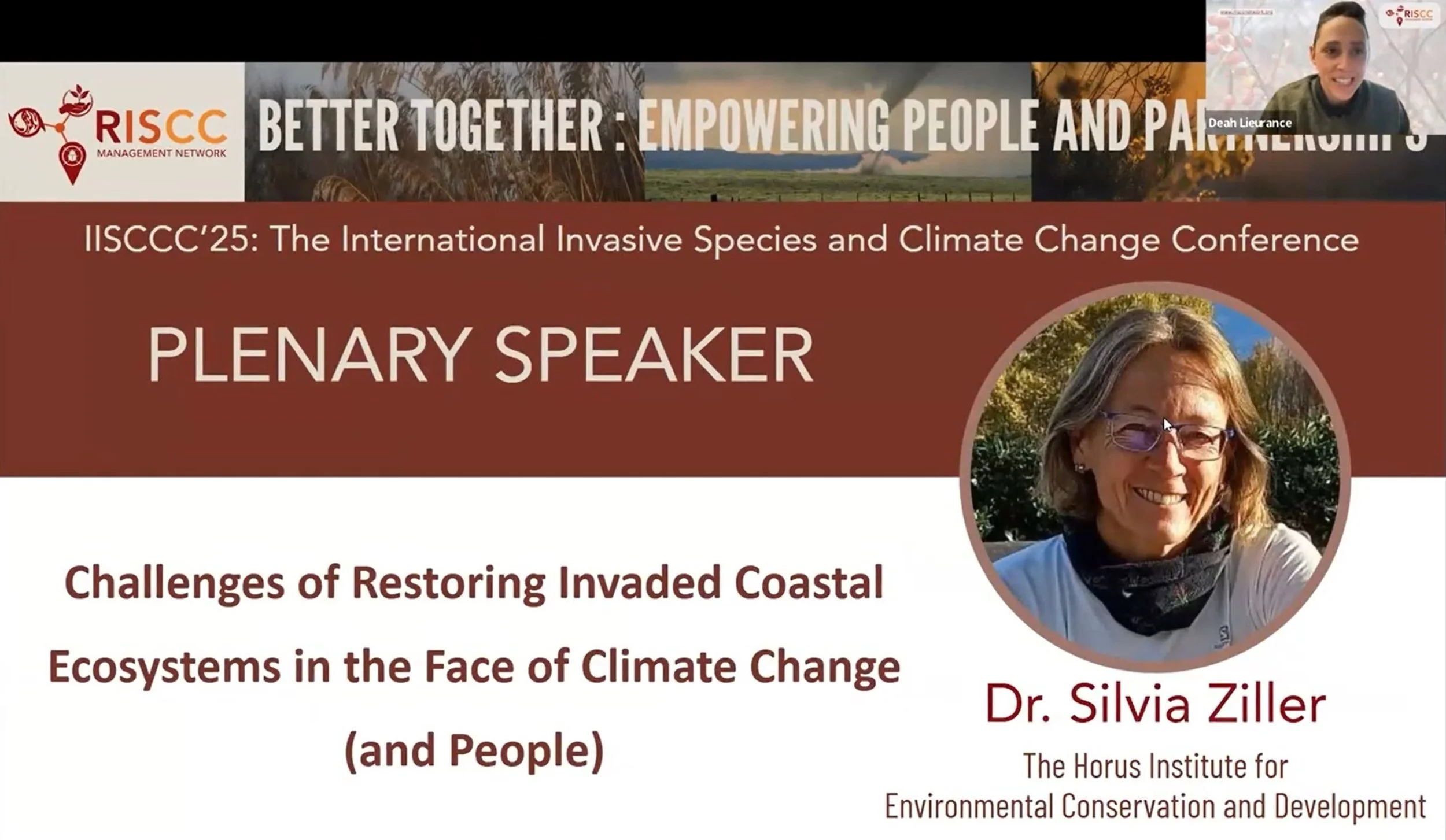
Challenges of restoring invaded coastal ecosystems in the face of climate change (and people)
Dr. Sylvia Ziller holds a PhD in Biological Invasions from the Federal University of Paraná in Brazil. In 2002 she founded the The Horus Institute for Environmental Conservation and Development, a non-profit organization that assists governments and private companies in addressing invasive species challenges across the region. Among her many contributions, Dr. Ziller and her team partnered with Universidad National del Sur in Argentina to launch a standardized invasive species database now operated in three languages across nine countries in Latin America and the Carribean. She supported the development of invasive species programs in multiple Brazilian states, advised ministries of the Environment across several countries on policies and adapted risk assessment protocols for regional application. The Horus Institute also leads restoration projects and delivers practical training to build capacity for on the ground management. With more than two decades of experience bridging science policy and practice, Dr. Ziller brings invaluable perspective to our discussions at the IISCCC.
Session #1: Resilient Futures: The Role of Invasive Species Management in Climate-Resilient Restoration
Panel Begins: 58:20
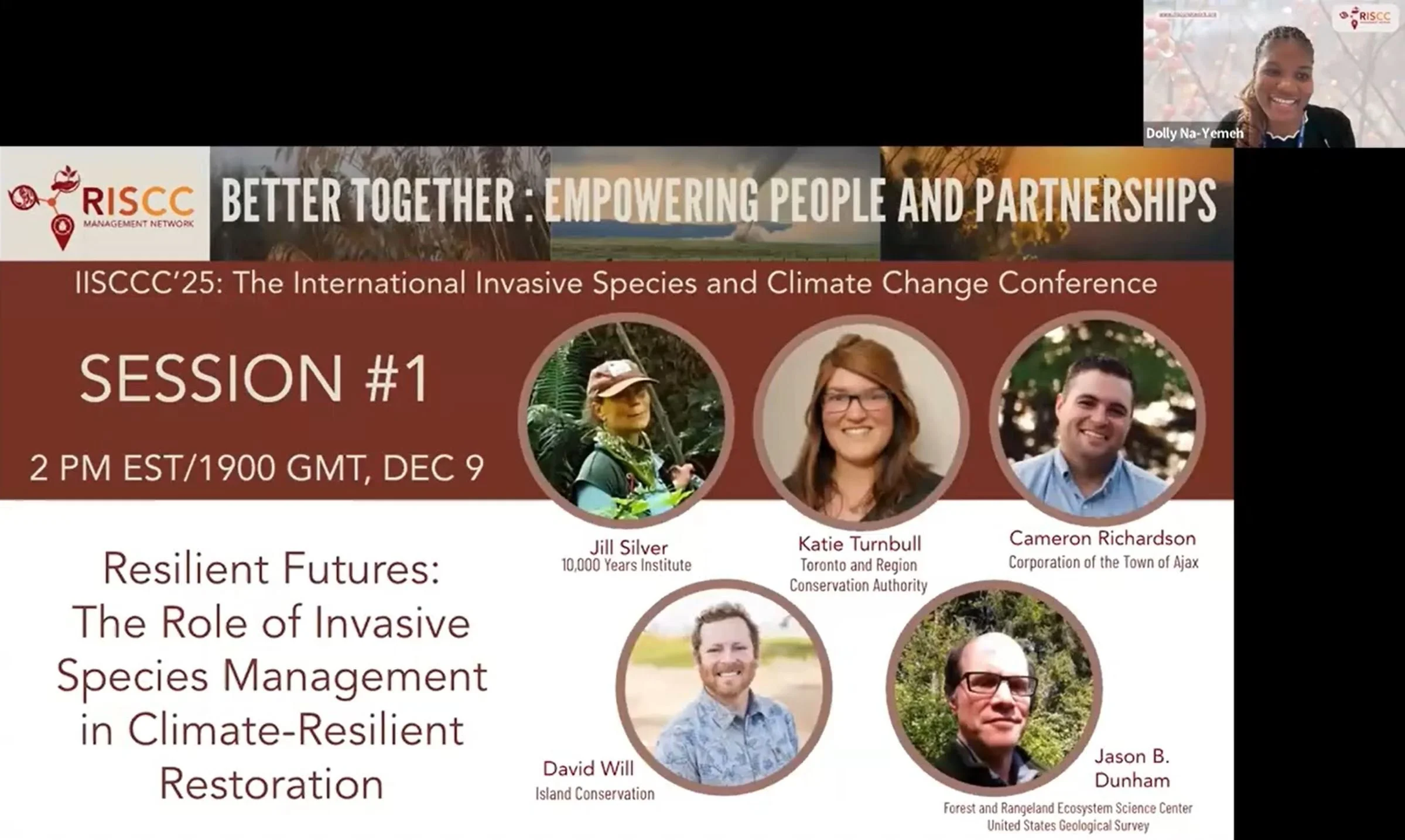
Moderated By: Dolly Na-Yemeh (College of Atmospheric and Geographic Sciences, University of Oklahoma) and Eva Colberg (Northwest RISCC and Northwest Climate Adaptation Science Center, Climate Impacts Group, University of Washington), the presentation featured the following speakers:
Jill Silver (10,000 Years Institute), “Protecting Watershed Resiliency, Biodiversity and Climate: Preventing the Spread of Invasives on the Olympic Coast”
Katie Turnbull (Toronto and Region Conservation Authority) and Cameron Richardson (Corporation of the Town of Ajax), “Collaboration in Action: Strategic Planning for Invasive Phragmites Control in Ajax, Ontario”
Dave Will (Island Conservation), “Scalable Monitoring for Resilient Futures: NASA Earth Observations in Island Restoration and Invasive Species Management”
Jason Dunham (Forest and Rangeland Ecosystem Science Center, U.S. Geological Survey), “ Control or coexistence? Adapting Resist-Accept-Direct to bull trout recovery”
Session #2: Understanding & Managing Pathways of Introduction & Spread
Session Begins At: 2:22:19
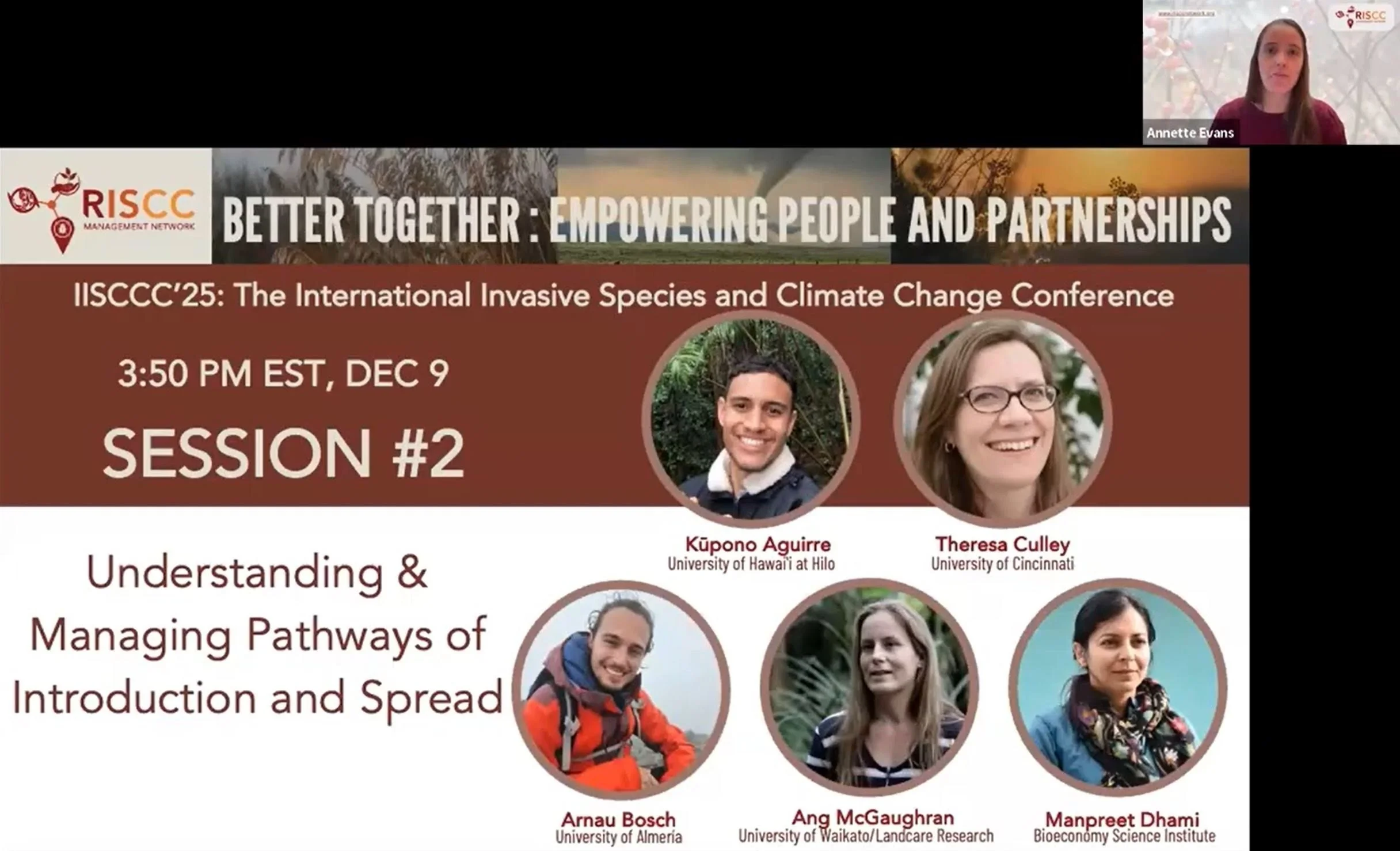
Moderated By: Annette Evans (Northeast RISCC and University of St. Joseph) and Deah Laurence (The Pennsylvania State University), the session featured talks by:
Kūpono Aguirre (University of Hawaiʻi at Hilo, Hawai'i, USA), “Seed Dispersal by Wild Pigs in Hawaiian Forests”
Theresa Culley (University of Cincinnati, USA), “Extreme Weather Events and Plant Invasions: The Impact of a Tornado on a Deciduous Forest”
Arnau Bosch (Estacion Experimental de Zonas Aridas, University of Almería, Spain), “From lowlands to summits: Pathways and dynamics of plant invasions in mountains”
Deah Laurence (The Pennsylvania State University), “Climate-smart adaptive biosecurity to manage introduction pathways into protected areas”
Plenary Speaker:
Ross Cuthbert, PhD (Queen’s University- Belfast)
Talk Begins at 5:17
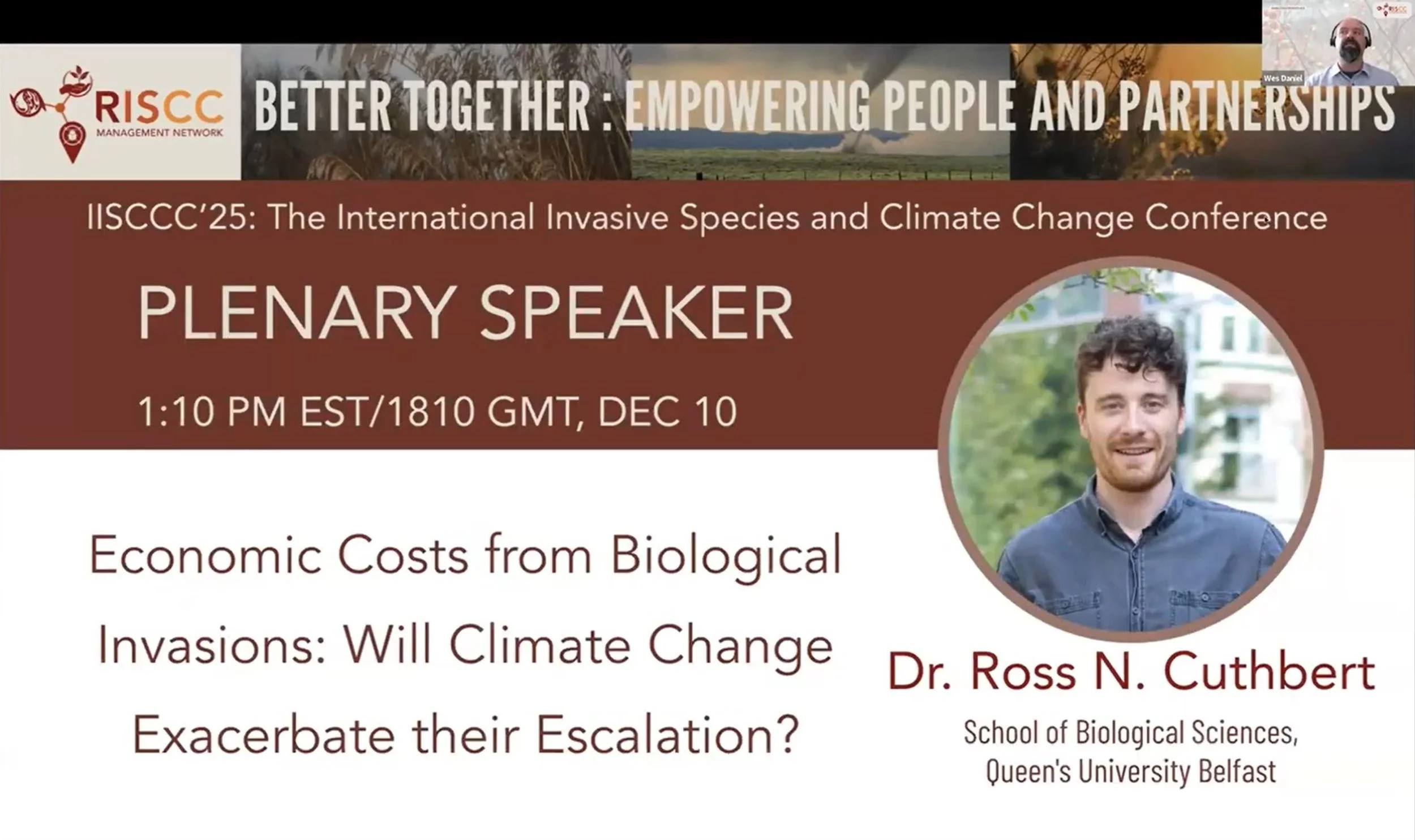
Economic costs from biological invasions: will climate change aggravate their escalation?
Dr. Ross Cuthbert a lecturer based at Queen's University Belfast in the School of Biological Sciences. He has a MsC in Ecological Management and Conservation Biology and a PhD in Biology from Queen’s University Belfast. He is also a research associate at the South Africa Institute for Aquatic Biodiversity and a member of the Young Academic Ireland. Ross’s research primarily focuses on quantifying and predicting the impacts of biological invasions and disease vector biology on ecosystems, economies and health with the aim of improving management strategies. He has also developed approaches to better understand the spatial and temporal dynamics of invasion and their impacts. He previously held fellowships that were funded by the Leverhulme Trust at Queen’s University Belfast and the Alexander von Humboldt Foundation for the Center of Ocean Research. He serves on the editorial boards of Marine Biology and NeoBiota.
Session #3: Management Success Stories: Sustaining Hope During a Time of Transformation
Session Starts At: 58:54

Moderated by: Cayla Morningstar (Southeast RISCC and University of Florida), the session featured talks by:
Patrícia Louro (Freelancer consultant for Municipio de Melgaço, Portugal), “Cooperation to tackle the invasion of the aquatic species, Ludwigia peploides”
Austin McCloskey (Shoalwater Bay Indian Tribe), “Tribal action to European green crab removal fuels compost for community”
Brian Tucker (University of Hawaii - Pacific Cooperative Studies Unit), “Managing Rapid ‘Ōhi‘a Death pathogens under a changing climate”
Alexis Mowery (Maryland Department of Natural Resources), “Small scale victories against large scale invasive plants in a Maryland state park”
Bryan Falk (U.S. National Invasive Species Council), “Uniting invasive species managers and emergency managers in disasters”
Session #4: Emerging Insights from Early Career Scientists
Session Starts At: 2:17:53

Moderated by: Toni Lyn Morelli (Northeast RISCC, Northeast Climate Adaptation and Science Center, and United States Geological Survey), this session featured talks by:
Matthew Fertakos (Northeast RISCC, Northeast Climate Adaptation Science Center, University of Massachusetts Amherst), “Propagule pressure from U.S. plant sales explains establishment but not invasion”
Taylor Woods (USGS, Eastern Ecological Science Center), “Risk assessment of invasive fishes across five large landscapes”
Annabelle Lamoureux (University of Quebec at Rimouski in collaboration with Fisheries and Oceans Canada and NOVA University of Lisbon), “Molecular and Cellular Mechanisms of Cold Tolerance in Males and Females of the Invasive Green Crab Carcinus Maenas: Implications for Geographical Range Expansion Under Climate Change”
Henrique Couto (cE3c - Center for Ecology, Evolution and Environmental Changes), “Understanding the Spread: the Origin and Distribution of Non-Native Lepidopterans”
Kayleen Falenstein (Edmonton and Area Land Trust), “Expanding capacity for invasive plant control on privately conserved lands”
Conference Organized By:
Eva Colberg (Northwest RISCC and Northwest Climate Adaptation Science Center, Climate Impacts Group, University of Washington)
Wes Daniel (Southeast RISCC and United States Geological Survey)
Annette Evans (Northeast RISCC and University of St. Joseph)
Nate Hofford (North Central RISCC and the University of Colorado)
Deah Laurence (Northeast RISCC and The Pennsylvania State University)
Stephanie Mladinich (South Central Climate Adaptation and Science Center and University of Oklahoma)
Toni Lyn Morelli (Northeast RISCC, Northeast Climate Adaptation and Science Center, and United States Geological Survey)
Cayla Morningstar (Southeast RISCC and University of Florida)
Chelsea Nagy (North Central RISCC and University of Colorado)
Dolly Na-Yemeh (South Central Climate Adaptation and Science Center and College of Atmospheric and Geographic Sciences, University of Oklahoma)
Elliot Parsons (Pacific RISCC, Pacific Climate Adaptation and Science Center and University of Hawai’i- Mānoa)
Christopher Sullivan (RISCC and Invasives Canada)